A Public Service or a Public Space? Two Different Kinds of Shared Resource
Learn to tell a public service from a public space, so you can classify a shared resource and understand whether the activity, setting, or both need attention.
The common mistake is to treat every publicly funded resource as one thing. That can blur whether residents rely on an organized activity, a shared place, or both—and what should continue if one part changes. To distinguish a public service from a public space, ask what people receive and what place they use.
Classify the resource by what people rely on
A public service is an organized activity or benefit, such as household waste collection, library lending, bus transportation, or fire response. A public space is a place people share, such as a park, plaza, public beach, or civic square.
The distinction is about function, not appearance. A library building is a place; borrowing books, getting reference help, and attending programs are services. A park remains a shared place even when a city-run recreation program takes place there.
Try a simple classification: name the benefit, name the place, and note whether people need both. That keeps a resource from being squeezed into a single label.
Separate what happens from where it happens
Many public resources combine a service and a setting. A public swimming pool is a place, while swim lessons, lane schedules, and lifeguard coverage are services. A transit station is a shared setting; train service, route information, and passenger assistance are activities connected to it.
This separation helps describe changes accurately. Say a recreation center remains open but a class is canceled: the place is available, while the program has changed. If the class is running but the entrance ramp is blocked, the activity continues but access to the setting is affected.
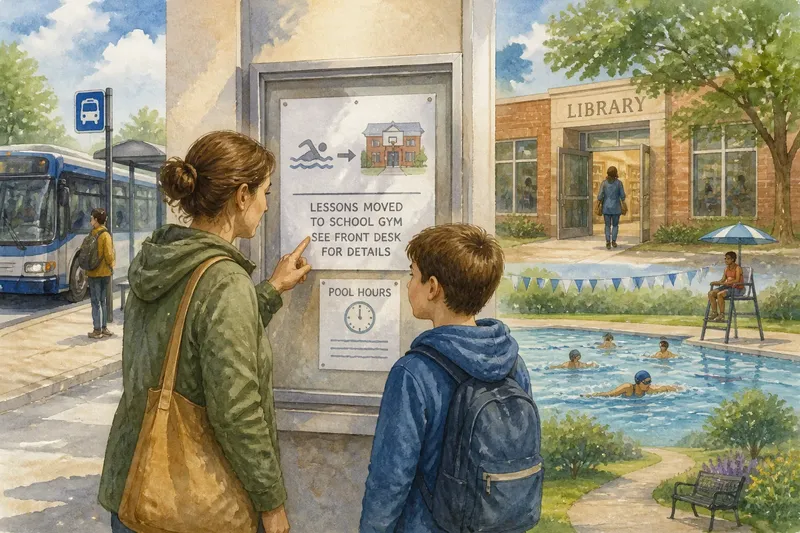
Imagine a resident arrives at a town recreation center for a scheduled class and finds the doors open, a notice that the class has moved to a school gym, and no change to the instructor or registration. The service has continued in a different setting; the practical question is whether the new location is accessible and clearly communicated. Naming those separate parts makes the situation easier to understand without treating the entire resource as unavailable.
Describe the activity, place, access route, or information separately.
Compare the resource’s parts before describing a change
When a shared resource changes, classify the change rather than relying on a broad label such as “closed” or “not working.” Ask what is still available and what has changed: the service, the place, the route to the place, or the information people need to use either one.
- Observe whether a waste collection notice changes the pickup day; if the collection continues on a new day, treat it as a service schedule change, otherwise check whether the service itself is suspended.
- Observe whether a library building is open while lending is paused; if other activities remain available, describe a service restriction, otherwise check whether access to the place is also affected.
- Observe whether a recreation class is moved to another venue; if the class still runs, classify the change as a setting change, otherwise classify it as a program interruption.
- Observe whether a park path is closed while other park areas remain open; if the rest of the grounds are accessible, describe a route restriction, otherwise check for a wider site closure.
- Observe whether a bus stop shelter is closed while buses still serve the stop; if buses continue, separate the shelter condition from the transit service, otherwise check whether service has also changed.
- Observe whether a plaza is reserved for an event while other areas remain open; if shared access remains, describe a limited-area restriction, otherwise check the extent of the closure.
Say you see a notice at a community pool stating that lessons have moved to a nearby school gym, while the pool remains open for regular swimming. The starting facts are a continuing lesson program and an unchanged pool schedule; the action is to compare the class notice with the pool’s posted hours and identify the new venue. The resulting classification is a service continuing in a different place, with a separate question about access to the gym.
Identify what public means in each case
Public does not always mean unrestricted at every moment. A service may have eligibility conditions, a service area, appointment availability, or a schedule. A public space may have closing hours, temporary closures, event reservations, or rules for activities that affect other users.
Distinguish the rule’s scope. A swimming lesson may require registration while the pool building has its own public hours. A park may remain open while a particular field is reserved; ask which activity or area the notice covers.
Check the current schedule or posted notice before making plans. The specific service or place may have different access conditions.
Which kind of shared resource are you dealing with?
Is a library a public service or a public space?
It can be both, depending on the part you mean. The building is a place people visit, while lending materials, providing reference help, and running programs are services.
Is public transportation a service or a place?
Routes, vehicles, and passenger assistance are services; a station or shelter is a place people use. A delayed bus and a blocked station entrance affect different parts of the resource.
Can a service continue if its usual place is unavailable?
Sometimes a program or activity can move to another venue, while a service tied directly to a particular site may not. Check whether the activity continues and whether the replacement setting is accessible to the people who rely on it.
Does public mean anyone can use a place or service at any time?
No. Services can have schedules or eligibility conditions, and public spaces can have hours, temporary restrictions, or rules for particular uses. Check the notice for the specific activity or area.
Use the distinction to understand what remains available
A service can continue while its usual setting changes, and a place can stay open while one activity is unavailable. Keeping those possibilities separate gives residents a more accurate picture of what they can still use.
When you see a change, name the resource’s parts plainly: what activity or benefit is involved, where it happens, and whether the access or information has changed. For a public service or public space, that classification is a useful starting point for understanding how the shared resource works.