A First Visit to a Shared Community Space: What to Notice
A first visit to a shared community space is easier when you know what to notice: who uses it, how its areas work, and where newcomers can find guidance.
The most common mistake on a first visit to a shared community space is treating the entrance as the whole story. A newcomer sees a welcome desk, a noticeboard, or a busy room and decides too quickly what the place is for; that can mean missing the quiet areas, the less visible users, or the information that makes a return visit easier. A little unhurried observation gives you a clearer picture without asking you to join in before you are ready.
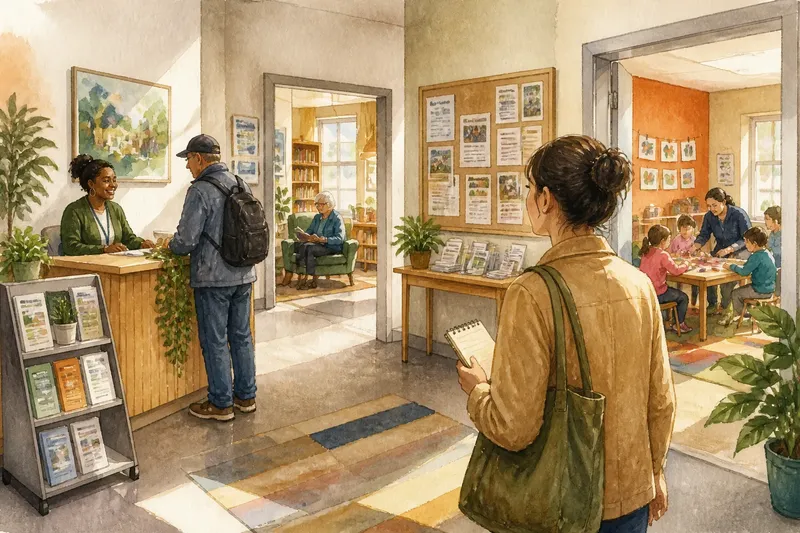
Say you are curious about a neighborhood community center you have passed many times. Imagine arriving on an ordinary weekday afternoon, with no appointment and no particular activity in mind. You can learn a lot by noticing who seems welcome, how people move through the building, and what the posted information says—then leave with a practical sense of whether and how you might return.
Begin with the welcome, not an assumption
At the entrance, look for the first points of contact: an open reception desk, a staffed counter, a sign-in sheet, or a board explaining how visitors can enter. These details suggest how the space handles arrivals, but they do not tell the whole story. A quiet entrance might simply mean that people come and go through another door or at another time.
Notice whether you can tell where to go without interrupting someone. Signs might identify a library corner, a food-pantry pickup, a meeting room, or a public restroom. If directions are unclear, asking a simple question such as “Is this area open to visitors?” is a reasonable way to begin. You do not need to explain your whole reason for being there.
Pay attention to the tone of the welcome as well as its form. A staff member may greet each person, or the space may be designed for people to move independently. Neither arrangement, by itself, tells you who belongs. Look for the combination of posted instructions, accessible routes, and everyday use.
Watch who the space serves
A shared place can serve several groups at once: residents seeking a cool place to sit, parents waiting for an activity, older neighbors meeting friends, or volunteers preparing supplies. On your first visit, avoid deciding that one visible group represents the whole community. The people present at that moment are a glimpse, not a complete picture.
Notice what people are doing and what the space makes possible. Are they reading, talking, waiting, getting information, or carrying materials between rooms? Are there seats arranged for conversation alongside chairs for someone who wants to be alone? Such clues reveal how people use the place without requiring you to interpret anyone’s personal circumstances.
Also look for signs that different visitors may have different needs. A children’s table, multilingual notices, a low counter, or a clearly marked quiet area can show that the space anticipates more than one kind of visit. These are useful observations, not proof that every need is met. If access, eligibility, or service hours matter to your plans, check the posted information or ask the organization responsible for the space.
Read the rooms as a small map
Move only through areas that appear open to visitors. Notice how the spaces connect: perhaps a shared lobby leads to a reading room, a community kitchen, and a bookable meeting room. Doors, signs, and furniture often explain the intended use more clearly than a general name such as “community hub.”
Compare the feel of each area. A large table may invite group work, while chairs placed near a window may suit a quiet pause. A display of local flyers might make a corridor useful for finding events, even if nobody is gathered there. The point is not to judge the design; it is to understand what you can do there and where different activities belong.
Pay attention to boundaries. A room can be part of the same building without being open for casual use; it may be reserved for a class, staff work, or a private appointment. If a door is marked or an activity is underway, stay in the public area and ask before entering. Respecting that distinction helps keep your visit comfortable for you and for the people already using the space.
Find the information that makes a return visit easier
Before leaving, look for the practical details a newcomer would need later. A noticeboard, printed leaflet, or official contact card may explain opening hours, recurring activities, room reservations, or how to ask about access. Check when the information was posted; an old flyer can remain visible after an event has passed.
Look for the name of the organization that manages the place, too. A community center may share its building with a library branch, a neighborhood group, or a local service provider, each with different schedules and contacts. Knowing which name appears on a notice helps you direct a question to the right people instead of assuming one desk handles everything.
If you find a useful activity, note its name and the contact method rather than relying on memory. A quick note on your phone—“ask the front desk about the open craft table”—is enough. You can decide later whether to attend, bring someone, or simply visit at a quieter time.
What should you notice on a first visit?
How can I tell whether a room is open to visitors?
Look for signs, an open doorway, or activity that appears intended for drop-in visitors. If the room’s status is uncertain, ask a staff member or host before entering rather than assuming that an unlocked door means public access.
Should I introduce myself to everyone?
No. A brief greeting to a staff member is enough if you need directions, and you can observe quietly if you are comfortable doing so. People using a shared space may be focused on their own activity, so let them set the pace for conversation.
What if the space seems empty?
An empty room during your visit does not necessarily mean the place is unused. Check the schedule or ask when activities usually take place, then choose whether a return visit suits you.
Can I take photos of signs or rooms?
Ask before photographing anything that could include people, personal information, or a restricted area. If you only need to remember an event, writing down its title and contact details is often simpler.
Let one visit become a useful decision
Imagine you arrive at the neighborhood center, find a welcome desk, and notice a lobby, a reading nook, and a room being used for a children’s activity. You read a current notice about a weekly repair café, ask whether visitors can drop in, and learn that the activity meets in the lobby rather than the reserved room. The observable result is a clearer plan: you know where to go, whom to ask for, and what to expect at a later visit.
That is enough for a first outing. You do not have to sign up, volunteer, or decide whether the place is “for you” before you leave. The visit has already answered practical questions about the space and given you room to choose your next move.
A first visit to a shared community space works best as a chance to gather modest, useful clues: who is there, how the areas are used, and where reliable information lives. Keep the organization’s name and one contact detail, and you can follow up when you are ready. That small note can turn an unfamiliar building into a place you know how to approach.